Pregnant Woman’s Beach Photos Go Viral, Leaving Social Media Users With One Big Question
A series of beach photographs featuring a young pregnant woman has sparked widespread curiosity on social media. What began as a seemingly ordinary moment celebrating pregnancy quickly attracted attention because of one striking detail: the unusually prominent size of her baby bump.
In the pictures, the woman poses near the ocean, appearing to enjoy a special moment during her pregnancy. However, as the images spread across social media, users began asking questions about her pregnancy and wondering whether she might be expecting more than one baby.
Could she be having twins? Could there be triplets? Is she nearing her due date, or could another factor explain the size of her abdomen?
The speculation spread quickly, but one important fact should not be overlooked: a photograph alone cannot determine how many babies a woman is expecting or whether her pregnancy is progressing normally.
The Photos That Caught Everyone’s Attention
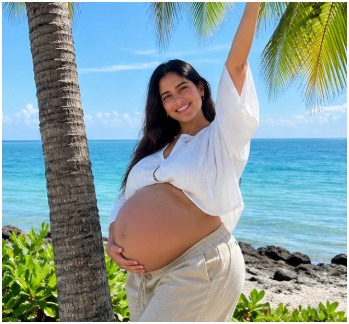
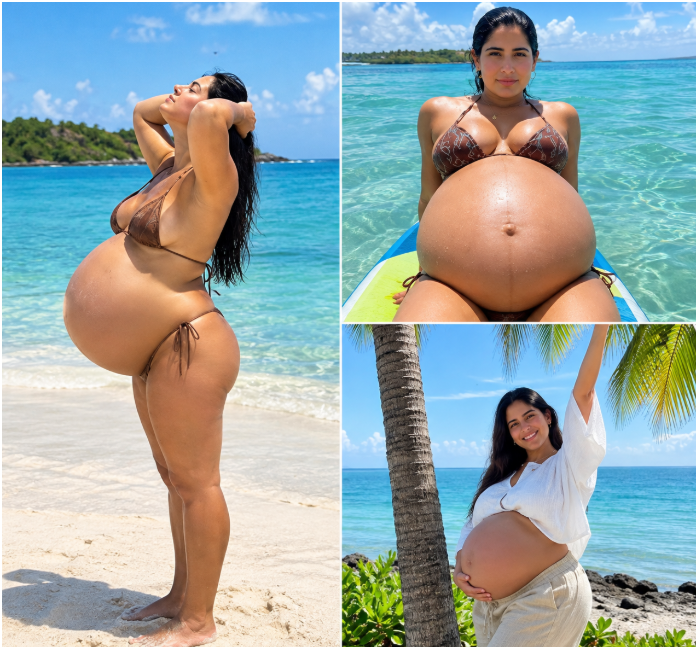
The images show the young woman posing on the sand and sitting near the water, proudly displaying her pregnant belly.
Although pregnancy photographs are common on social media, the appearance of her abdomen caught the attention of many viewers. Comments and theories soon began appearing beneath the pictures, with some people suggesting that she might be expecting twins or even triplets.
Others attempted to estimate how far along she might be based on her appearance.
However, these conclusions cannot be reliably drawn from photographs. The size and shape of a pregnant woman’s abdomen vary considerably, and appearances alone do not provide enough information to establish what is happening medically.
Does a Large Baby Bump Mean Twins or Triplets?
Not necessarily.
A multiple pregnancy can sometimes result in a more prominent abdomen, but many other factors influence how a pregnant woman looks.
These include the stage of pregnancy, the baby’s position, the mother’s body structure, previous pregnancies, and the amount of amniotic fluid surrounding the baby.
Even two women at exactly the same stage of pregnancy can have noticeably different belly shapes and sizes.
For this reason, there is no reliable visual rule that allows someone to determine the number of babies based on the size of a baby bump.
An Ultrasound Can Provide Important Answers
When it comes to determining whether a woman is expecting one baby or several, ultrasound examinations are an important part of prenatal care.
An ultrasound allows healthcare professionals to examine the pregnancy, identify the number of fetuses, assess development, and evaluate other aspects of the pregnancy.
Additional examinations may be recommended depending on the individual circumstances.
Without reliable medical information or confirmation from the woman herself, claims about twins, triplets, or any other pregnancy details remain speculation.
Could There Be Other Explanations?
Yes. Several factors can influence the appearance of a pregnant abdomen.
Amniotic fluid: The fluid surrounding the baby plays an important role during pregnancy. An amount outside the expected range may require medical assessment, but it cannot be diagnosed from a photograph.
Previous pregnancies: The abdominal muscles and surrounding tissues may respond differently in subsequent pregnancies, affecting the appearance of the belly.
Individual body structure: Height, torso length, body proportions, and other anatomical characteristics can influence how prominently the abdomen projects.
The baby’s position: The way a baby lies inside the uterus can also affect the visible shape of the abdomen.
These differences illustrate why comparing one pregnant woman with another rarely provides meaningful medical information.
There Is No Single Normal Baby-Bump Size
Pregnancy changes every woman’s body differently.
Some women develop prominent baby bumps relatively early, while others have less noticeable abdomens at the same stage. Neither appearance alone establishes whether a pregnancy is healthy.
Social media comparisons can create unnecessary anxiety when people begin judging pregnancy progress by photographs.
Comments such as “She must be having twins” or “I was much smaller at nine months” might sound harmless, but they cannot replace professional medical assessments.
Healthcare providers consider clinical examinations, pregnancy history, appropriate measurements, and imaging results when evaluating development.
Multiple Pregnancies May Require Closer Monitoring
When a woman is expecting twins or more babies, her healthcare team may recommend additional prenatal appointments and examinations.
This helps monitor the babies’ growth and identify potential complications as early as possible.
However, the appropriate monitoring schedule depends on the specific pregnancy and the advice of qualified healthcare professionals.
It should never be determined by social media comments or assumptions based on someone’s appearance.
Could the Photographs Have Been Edited?
Some viewers may also wonder whether the images accurately represent the woman’s appearance.
Photographs can sometimes be altered through editing software, filters, unusual camera angles, or artificial intelligence. Digitally generated images can also resemble genuine photographs.
Nevertheless, an unusual appearance does not prove that an image has been manipulated.
Without access to the original photographs and reliable information about their source, it would be unfair to claim that the images are authentic or edited.
How a Single Photograph Can Become an Internet Sensation
Social media allows photographs to travel rapidly from personal accounts to thousands of pages and online communities.
As images are shared, additional details may be attached to them, including unverified claims about the person’s identity, pregnancy stage, or number of babies.
When the same claim appears repeatedly, readers may begin to accept it as fact even when no reliable evidence supports it.
That is why it is important to distinguish between what a photograph actually shows and what viewers assume it means.
The Importance of Respecting Pregnant Women
Pregnancy is a deeply personal experience that brings significant physical and emotional changes.
When photographs become viral, the woman featured may suddenly find strangers discussing her body, weight, and private circumstances.
Even comments made out of curiosity can feel intrusive when thousands of people speculate about someone’s personal life.
Rather than turning a person’s appearance into a source of judgment, social media users can choose to respond with kindness and respect.
Curiosity does not justify making unsupported medical claims or spreading unverified personal information.
So, How Many Babies Is She Expecting?
That remains the central question for many viewers, but the photographs alone cannot provide an answer.
She could be expecting one baby, twins, or more. Other factors could also explain the appearance of her abdomen.
Without reliable confirmation, choosing any one of these possibilities would be speculation.
It is equally impossible to establish the exact stage of pregnancy or determine whether the pregnancy is progressing normally simply by examining the images.
What We Can Actually Learn From the Photos
The photographs appear to show a young pregnant woman enjoying a coastal setting and posing with a noticeably prominent baby bump.
That visible detail explains why the images attracted attention, but it does not establish any further medical facts.
The number of babies, the precise stage of pregnancy, and the mother’s medical circumstances cannot be reliably determined from appearance alone.
The most responsible approach is to avoid treating online theories as confirmed information.
Conclusion: A Viral Photo Cannot Tell the Whole Story
The beach photographs of this young pregnant woman have sparked curiosity and generated numerous theories about the size of her abdomen.
Questions about twins, triplets, and multiple pregnancies have become part of the online discussion, demonstrating how quickly a single image can capture public attention.
Yet the most important lesson is that a large baby bump does not automatically mean a woman is expecting several babies.
Every pregnancy is different, and many factors influence how a woman’s body changes throughout those nine months.
Ultimately, reliable medical assessments and appropriate prenatal examinations provide far more meaningful information than photographs or online speculation.
Sometimes, the most responsible response to a viral image is not to guess what it means, but to remember that there is a real person behind it who deserves privacy, dignity, and respect.